Telco company

2024

Redesigned login to enable seamless cloud migration
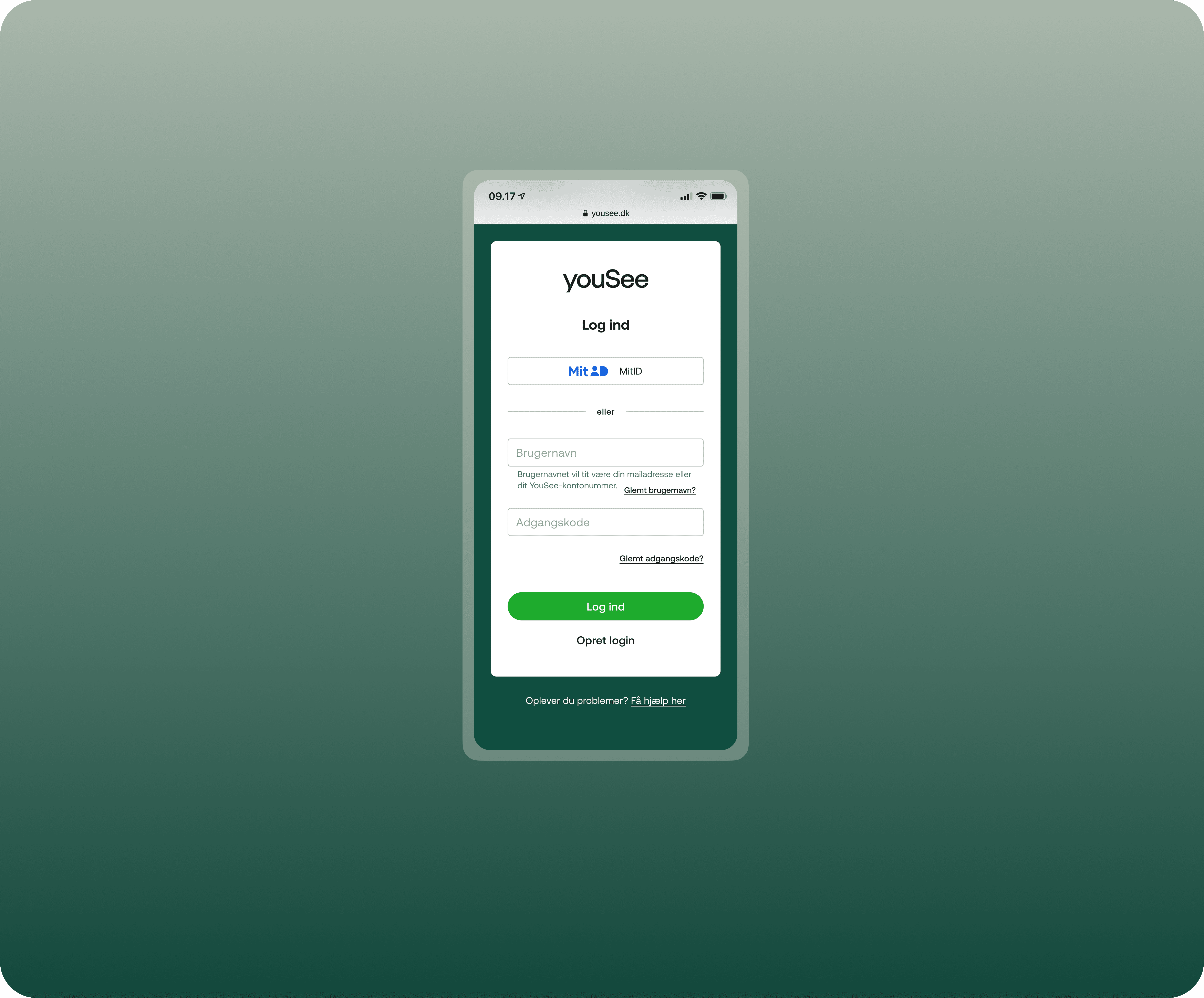
The telco I worked for was transitioning to a new cloud infrastructure, requiring a complete redesign of the self-service portal and login experience to align with the updated system architecture. Data showed that a significant amount of customers struggled to retrieve their password and username and found error messages vague. This led to a redesign that focused on streamlining account recovery, aligning brand standards and providing clear and actionable error messages.

The telco I worked for was transitioning to a new cloud infrastructure, requiring a complete redesign of the self-service portal and login experience to align with the updated system architecture. Data showed that a significant amount of customers struggled to retrieve their password and username and found error messages vague. This led to a redesign that focused on streamlining account recovery, aligning brand standards and providing clear and actionable error messages.

Role

UX Designer

Team

1x Product Manager

2x Engineers

1x UX Designer

Impact

Reduced customer support burden

Strengthened brand consistency and user trust

Enabled user self-service and independence

Role

UX Designer

Team

1x Product Manager

2x Engineers

1x UX Designer

Impact

Reduced customer support burden

Strengthened brand consistency and user trust

Enabled user self-service and independence

Role

UX Designer

Team

1x Product Manager

2x Engineers

1x UX Designer

Impact

Reduced customer support burden

Strengthened brand consistency and user trust

Enabled user self-service and independence

Problem area

Ensuring seamless login redesign

Data analysis revealed customers struggling to recover usernames and passwords, compounded by vague error messages that drove support demand and eroded self-service trust.

To address this, I led the redesign of a secure, intuitive login flow ensuring seamless authentication and brand consistency. This solution supported cloud migration, minimised friction, boosted customer confidence, and reduced login-related support calls and password resets.

Problem 1

Support call data revealed many inquiries from customers unable to recover forgotten usernames or passwords. This login friction caused high support volume and indicated the account recovery process was unclear and inaccessible.

Problem 1

Support call data revealed many inquiries from customers unable to recover forgotten usernames or passwords. This login friction caused high support volume and indicated the account recovery process was unclear and inaccessible.

Problem 1

Support call data revealed many inquiries from customers unable to recover forgotten usernames or passwords. This login friction caused high support volume and indicated the account recovery process was unclear and inaccessible.

Problem 2

The login design did not follow the telco's design system or brand guidelines, causing a disjointed experience that increased cognitive load and weakened brand recognition.

Problem 2

The login design did not follow the telco's design system or brand guidelines, causing a disjointed experience that increased cognitive load and weakened brand recognition.

Problem 2

The login design did not follow the telco's design system or brand guidelines, causing a disjointed experience that increased cognitive load and weakened brand recognition.

Problem 3

Error messages during login were vague and unhelpful, causing user frustration and increased support requests due to unclear guidance on how to resolve issues.

Problem 3

Error messages during login were vague and unhelpful, causing user frustration and increased support requests due to unclear guidance on how to resolve issues.

Problem 3

Error messages during login were vague and unhelpful, causing user frustration and increased support requests due to unclear guidance on how to resolve issues.

Design goals

What I aimed to achieve

Streamline account recovery and reduce support load

Designing a clear, intuitive account recovery flow that enabled users to independently resolve forgotten username or password issues, reducing support call volume and improving user confidence.

Streamline account recovery and reduce support load

Designing a clear, intuitive account recovery flow that enabled users to independently resolve forgotten username or password issues, reducing support call volume and improving user confidence.

Streamline account recovery and reduce support load

Designing a clear, intuitive account recovery flow that enabled users to independently resolve forgotten username or password issues, reducing support call volume and improving user confidence.

Align design with brand standards

Ensuring the login experience adhered to design system and brand guidelines, creating visual and interaction consistency that strengthened brand recognition and trust.

Align design with brand standards

Ensuring the login experience adhered to design system and brand guidelines, creating visual and interaction consistency that strengthened brand recognition and trust.

Align design with brand standards

Ensuring the login experience adhered to design system and brand guidelines, creating visual and interaction consistency that strengthened brand recognition and trust.

Provide clear, actionable error messages

Redesigning error messaging to be specific and solution-oriented, guiding users toward the correct action and minimizing support inquiries.

Provide clear, actionable error messages

Redesigning error messaging to be specific and solution-oriented, guiding users toward the correct action and minimizing support inquiries.

Provide clear, actionable error messages

Redesigning error messaging to be specific and solution-oriented, guiding users toward the correct action and minimizing support inquiries.

Design decision 01

Intuitive account recovery flow to reduce support inquiries

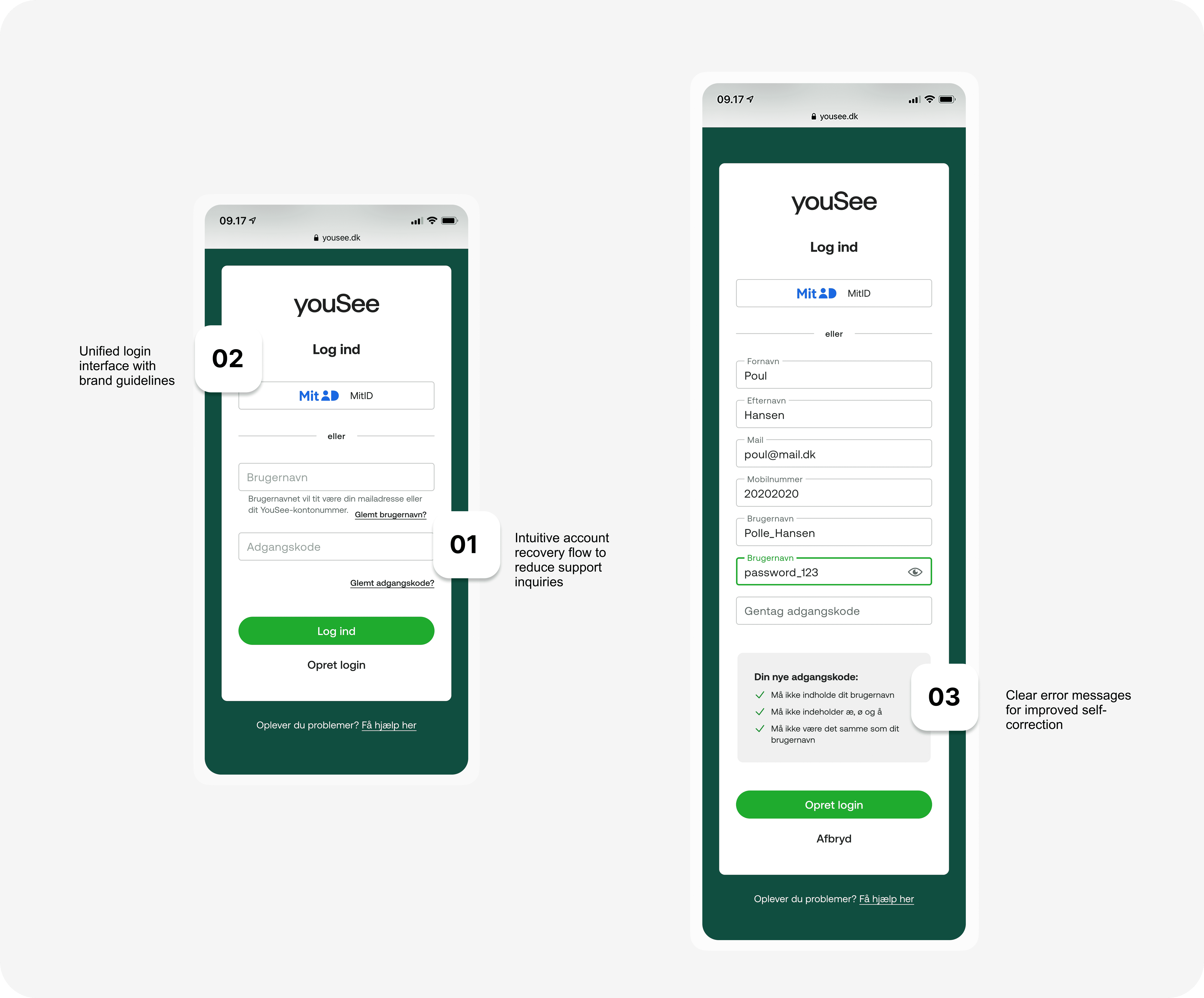
Designed an intuitive account recovery experience by strategically placing "Forgot Username?" and "Forgot Password?" links directly beneath their corresponding input fields. This contextual placement reduced cognitive friction, enabling users to quickly locate and access recovery options without leaving the login flow, thereby streamlining the account recovery process and reducing support inquiries.

Design decision 02

Unified login interface with brand guidelines

Applied YouSee's established design system and brand guidelines throughout the login interface, including consistent typography, colour palette, spacing, and interaction patterns. This cohesive approach created a unified visual language that reinforced brand recognition, enhanced user trust, and ensured seamless continuity between the login page and the broader self-service portal experience.

Design decision 03

Clear error messages for improved user self-correction

Redesigned error messages to be specific, actionable, and user-friendly, replacing vague alerts with clear explanations of what went wrong and how to resolve it. Each error message now provides contextual guidance—such as "Username must contain 6+ characters" or "Password incorrect. Try again or reset your password"—enabling users to self-correct independently and reducing dependency on support channels.
Retrospective
Streamlined login for reduced support and enhanced self-service

Before and After redesign

Impact

Reduced customer support burden

By streamlining the account recovery flow and providing clear, actionable error messaging, support calls related to login issues decreased significantly, freeing support resources for more complex inquiries and improving overall operational efficiency.

Reduced customer support burden

By streamlining the account recovery flow and providing clear, actionable error messaging, support calls related to login issues decreased significantly, freeing support resources for more complex inquiries and improving overall operational efficiency.

Reduced customer support burden

By streamlining the account recovery flow and providing clear, actionable error messaging, support calls related to login issues decreased significantly, freeing support resources for more complex inquiries and improving overall operational efficiency.

Strengthened brand consistency and user trust

Aligning the login experience with YouSee's design system created a cohesive, professional interface that reinforced brand recognition across the self-service portal, enhancing user confidence and trust in the platform.

Strengthened brand consistency and user trust

Aligning the login experience with YouSee's design system created a cohesive, professional interface that reinforced brand recognition across the self-service portal, enhancing user confidence and trust in the platform.

Strengthened brand consistency and user trust

Aligning the login experience with YouSee's design system created a cohesive, professional interface that reinforced brand recognition across the self-service portal, enhancing user confidence and trust in the platform.

Enabled user self-service and independence

Clear account recovery options and helpful error messages empowered customers to resolve login issues independently, improving user satisfaction and reducing friction in the authentication experience.

Enabled user self-service and independence

Clear account recovery options and helpful error messages empowered customers to resolve login issues independently, improving user satisfaction and reducing friction in the authentication experience.

Enabled user self-service and independence

Clear account recovery options and helpful error messages empowered customers to resolve login issues independently, improving user satisfaction and reducing friction in the authentication experience.